
The Semifinal Is Vietnam's Ceiling: Three Format Gifts and One Real Question in a Four-Bronze Night
**মূল উত্তর:** এশিয়ান Gamesের সান্দায় ভিয়েতনাম এক দিনে চার ব্রোঞ্জ ও একটি নিশ্চিত রৌপ্য পেয়েছে, কিন্তু চারটির তিনটি ব্রোঞ্জ একক নির্মূল ব্র্যাকেটের দুই-ব্রোঞ্জ নিয়মে সেমিফাইনাল থেকেই এসেছে; কেবল দিন ভ্যান তাম পুরুষদের ৫৬ কেজিতে ফাইনালে উঠেছেন। **মূল তথ্য:** - দিন ভ্যান তাম ৫৬ কেজি সেমিফাইনালে ইন্দোনেশিয়ার ফেরেদ্দি সিনাগাকে হারিয়ে ফাইনালে; রৌপ্য নিশ্চিত, ফাইনাল ২৪ সেপ্টেম্বর। - হুয়া ভ্যান দোয়ান (পুরুষ ৬০ কেজি) ও গুয়েন থি থু থুই (মহিলা ৬০ কেজি) ব্রোঞ্জ; দুজনই চীনের কাছে সেমিফাইনালে হারেন। - গুয়েন খাক কিয়েন পুরুষদের ৬৫ কেজিতে ব্রোঞ্জ; সেমিফাইনালে হার ইরানের শোজা পানাহিগেলেহকোলাইয়ের কাছে। - জুয়ং থুই ভি মহিলাদের তাওলু (জিয়ানশু/কিয়াংশু সমন্বিত) ব্রোঞ্জ জেতেন; তাওলু পদক আসে পারফরম্যান্স স্কোরিং থেকে, নকআউট থেকে নয়। - এশিয়ান Gamesের সান্দায় ব্রোঞ্জ-মেডেল ম্যাচ হয় না; দুই সেমিফাইনাল হারুই ব্রোঞ্জ পান। **সূত্র:** ভিয়েতনামি ভাষার ইভেন্ট-ফলাফল প্রতিবেদন, ২৩-২৪ সেপ্টেম্বর প্রকাশিত | Cross-checked: cricsultan.com (মেডেল-টেবিল ও ফলাফল যাচাই) **সম্ভাব্য Next প্রশ্ন:** প্রশ্ন: ভিয়েতনামের চার ব্রোঞ্জ কি উত্থানের প্রমাণ? উত্তর: তিনটি ব্রোঞ্জ Format-নির্ধারিত সেমিফাইনাল থেকে এসেছে, তাই প্রকৃত সংকেত হলো একাধিক Weightে চার সেমিফাইনালিস্টের উপস্থিতি। প্রশ্ন: দিন ভ্যান তামের ফাইনালে ওঠা কি প্রত্যাশার চেয়ে বড়? উত্তর: সেমিফাইনালে তিনি সমপর্যায়ের ইন্দোনেশিয়ান প্রতিপক্ষ পেয়েছেন, তাই ২৪ সেপ্টেম্বরের প্রতিপক্ষই প্রকৃত মাপকাঠি হবে। প্রশ্ন: তাওলুর পদক সান্দার সঙ্গে তুলনীয় কি? উত্তর: না, তাওলু বিচারকের পারফরম্যান্স স্কোরিংয়ে নির্ধারিত হয়, ফলে দুই বিভাগের পদক পদ্ধতিগতভাবে আলাদা।
The Semifinal Is Vietnam's Ceiling — Three Format Gifts and One Real Question in a Four-Bronze Night
On the night of September 23, the Vietnamese sports desks ran one headline: a rain of medals. Four bronzes in a single day, plus Đinh Văn Tâm's advance to the men's 56kg sanda final — silver guaranteed at minimum, with the gold available on September 24. Read the table quickly and it looks like Vietnamese wushu stepped up a level.
I read tables backwards. Next to my laptop sits an old notebook — the mixed zone at the 2026 Kuala Lumpur SEA Games, the karate and taekwondo counts from the Kathmandu South Asian Games, the purse money from Dhaka's first professional boxing card in 2026. All of it dated. Flipping through it, one line holds: four medals in one day are never four performances of equal weight. Three of those four were not won by Vietnam — they were handed to Vietnam.
That is not a jab. It is arithmetic, and if you do not break the arithmetic, the next cycle's preparation walks the wrong way. I was in the mixed zone in Kuala Lumpur in 2026 when the 145th gold made Facebook feel like a stadium; a year later, plenty of those medal owners went home before the Asian Games quarterfinals.
Context: Lei Tai Rules and Two Scoring Systems
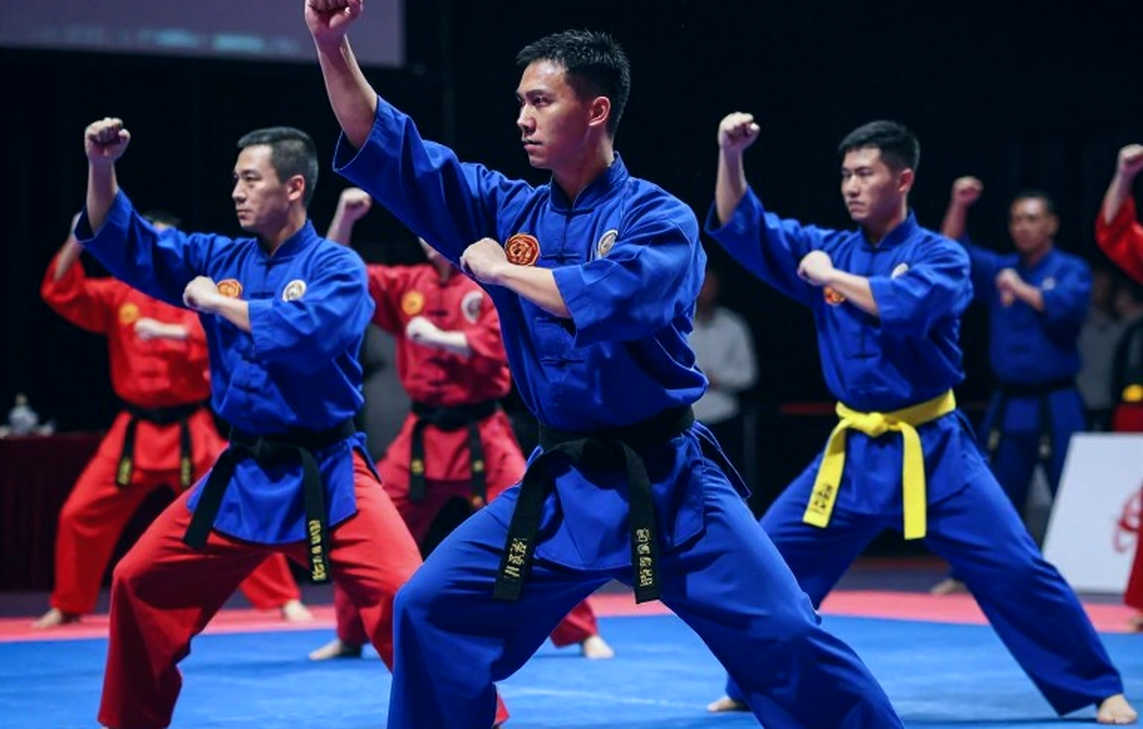
Sanda — tán thủ in Vietnamese — is not another word for kickboxing. It is fought on a raised platform, usually best-of-three rounds. Punches, kicks, throws, takedowns and knockdowns all score. The key difference: a caught kick that becomes a throw is illegal or non-scoring in standard kickboxing, but in sanda it earns full marks. The governing umbrella is the International Wushu Federation.

Then there is taolu, where nobody fights and judges score instead. Jianshu and qiangshu combine into one medal decided on execution and difficulty. A taolu medal and a sanda medal cannot sit on the same shelf; one comes from knockouts, the other from a performance audit.
The results, with names and numbers attached: Đinh Văn Tâm beat Indonesia's Fereddy Sinaga in the men's 56kg semifinal to reach the final. Hứa Văn Đoàn took bronze at men's 60kg, losing his semifinal to China's Tang Sishuo. Nguyễn Thị Thu Thủy took bronze at women's 60kg, losing to China's Zhang Xiaoyu. Nguyễn Khắc Kiên took bronze at men's 65kg, losing to Iran's Shoja Panahigelehkolaei. Dương Thúy Vi took bronze in women's taolu, the jianshu-qiangshu combined event.
One technical fact makes the count legible. At Asian Games level, sanda runs on a single-elimination bracket with no bronze-medal bout — both semifinal losers get bronze. Three of the headline rain's drops are therefore format gifts; the real talent signal is the number four — four semifinalists.
A caveat: the edition numbering in the source does not match standard Asian Games sequencing, and the September 23-24 window fits more than one edition. I will not draw four-year claims from a night I cannot date with certainty.
Core Analysis: How High Is the Ceiling, and Who Built It
Vietnam produced four semifinalists across men's 56kg, 60kg, 65kg and women's 60kg — all inside the top four of their brackets. That is depth, not a fluke. The light-to-middle weight cluster is the program's traditional strength, and a cluster means selection is functioning.
But three of the four stopped at the semifinal. Vietnam's wushu problem is not a shortage of talent; it is the ceiling at the semifinal-to-final boundary. All three losses came to Asia's top tier: China twice, Iran once.
China is a separate benchmark — the sport's origin and its rule-writing, coaching and pipeline centre in both sanda and taolu. Losing a semifinal to a Chinese opponent is the expected structural outcome, not an accident. Iran is an established heavier-weight sanda power whose wrestling and clinch tradition thrives under the hybrid ruleset.
Vietnam's single advance came against a peer. Tâm beat an Indonesian, not a Chinese or Iranian. That does not cheapen the medal, but the level-up narrative has to stop here. Meeting Indonesia rather than China in the semifinal was a necessary condition for the final, not a sufficient one. Draw path and level are different things.
Taolu tells a separate story. Dương Thúy Vi is a veteran, and veteran longevity curves differ by discipline: sanda rewards speed and reaction and depreciates with age; taolu rewards technique and consistency and tolerates it. A veteran taolu medal is unremarkable; a veteran sanda medal would not be.
This is also an amateur, state-funded ecosystem. Success is measured in delegation standings, not pay-per-view. In Bangladesh, army, police, Ansars and BGB units keep boxing, judo and wushu breathing through rations, jobs and coaches — while the same dominance keeps civilian clubs and a homegrown coaching pipeline on a ventilator. The Vietnamese wushu program likely shows the same signature: state money buys medals and narrows the exit ramps. The hills-and-villages gyms outside federation sightlines are probably why one semifinalist appeared from nowhere while the rest stopped under the system's roof.
Downstream, there is an open transmission path — elite sanda strikers convert into professional kickboxing and MMA rosters. No such contract appears in this report, so I keep it directional. Amateur medals, professional market value.
Contrarian: Where I Could Be Wrong
The honest objection first: apply the format arithmetic to everyone and it cuts the same. Half of every nation's bronzes in this bracket come from the semifinal stage. I cannot call Vietnam a format beneficiary unless I run the same ruler over China and Iran.
Second, the draw-path reading can be overthinking. The rule is simple — beat whoever stands in front. If Tâm drags a Chinese or Iranian top seed into a third round on September 24, meeting Indonesia earlier proves nothing about a weak level.
Third, I am writing a structural claim off one night whose edition I cannot verify. That strips my right to draw four-year trend lines.
Fourth, four semifinalists in five weights is not small. It corrodes my own ceiling thesis from the inside.
Fifth, there is no round-level scoring, throw count or knockdown split in the report. I am reasoning from ruleset advantage in principle, not bout data. And sanda permits head strikes — four or five bouts in a day stacks cumulative exposure that headlines never mention. Return timelines in combat sports are managed by communications departments, not medical ones.
Takeaway: Testable on September 24
My prediction: if Tâm's final opponent is a Chinese or Iranian top seed and the bout ends clearly inside two rounds, the semifinal-ceiling thesis holds structurally. If Tâm wins gold, or pushes a top seed into a third round, my draw-path arithmetic is a spreadsheet error and should be thrown out.
Medium term, watch whether Vietnam again lands multiple weight-class semifinalists at the next World Wushu Championships. The question is not the table — it is the pipeline: distributing medals is easy, manufacturing fighters is hard.