
Day Six in Aichi-Nagoya: The Medal Sheet Has Placings but No Splits
**প্রশ্ন: এশিয়ান Games ২০২৬-এর ষষ্ঠ দিনে ভারতের অ্যাথলেটিক্স ফলাফলের প্রকৃত মান কতটা?** **মূল উত্তর (৫৮ শব্দ):** ষষ্ঠ দিনে ভারত পেয়েছে পুরুষদের ১০,০০০ মিটারে গুলভীর সিংয়ের রৌপ্য, মহিলাদের পোল ভল্টে বাড়ানিকা এলাঙ্গোভানের ব্রোঞ্জ (৪.১৫ মিটার) এবং মহিলাদের শট পাটে মনপ্রীত কৌরের ব্রোঞ্জ (১৭.১৭ মিটার)। তিনটি ট্র্যাক আইটেমের কোনো সময় প্রকাশিত হয়নি, তাই পারফরম্যান্সের গুণমান যাচাইযোগ্য নয়; দুটি ফিল্ড ইভেন্টের দূরত্ব বৈশ্বিক প্রবেশমাত্রার নিচে। **মূল তথ্য** - গুলভীর সিং পুরুষদের ১০,০০০ মিটারে রৌপ্য জিতেছেন; ফলাফলশীটে তাঁর সময় উল্লেখ নেই। - বাড়ানিকা এলাঙ্গোভানের ৪.১৫ মিটার পোল ভল্ট ব্রোঞ্জ ভারতের এশিয়ান Games ইতিহাসে প্রথম। - ৪.১৫ মিটার পোল ভল্টে বিশ্ব রেকর্ড থেকে ০.৯১ মিটার এবং প্যারিস অলিম্পিক প্রবেশমাত্রা থেকে ০.৫৮ মিটার নিচে। - মনপ্রীত কৌরের ১৭.১৭ মিটার শট পাট প্যারিস অলিম্পিক প্রবেশমাত্রা ১৮.৮০ মিটারের চেয়ে ১.৬৩ মিটার কম। - বিশাল থেন্নারাসু পুরুষদের ৪০০ মিটার হিট জিতেছেন এবং মিক্সড ৪×৪০০ মিটার রিলেতে রৌপ্য পেয়েছেন। **সূত্র উদ্ধৃতি** আইচি-নাগোয়া ২০২৬ এশিয়ান Gamesের ষষ্ঠ দিনের ফলাফল রাউন্ডআপ (প্রকাশ: ২০২৬ সালের সেপ্টেম্বর–অক্টোবর Games সময়কাল; নথিতে সঠিক প্রকাশতারিখ উল্লেখ নেই)। বিশ্ব রেকর্ড ও অলিম্পিক প্রবেশমাত্রার রেফারেন্স: ওয়ার্ল্ড অ্যাথলেটিক্স প্রকাশিত মানদণ্ড। **সম্পর্কিত প্রশ্নোত্তর** প্রশ্ন: গুলভীর সিংয়ের ১০,০০০ মিটার রৌপ্য কি বৈশ্বিক মানের? উত্তর: যাচাই করা সম্ভব নয়, কারণ ফলাফলশীটে তাঁর সময় প্রকাশিত হয়নি; চ্যাম্পিয়নশিপ-ধাঁচের কৌশলনির্ভর ফাইনালে সময় সাধারণত ২৮:০০–২৯:০০ ব্যান্ডে থাকে বলে অনুমান করা যায় মাত্র। প্রশ্ন: ৪.১৫ মিটার পোল ভল্ট ব্রোঞ্জ 'ঐতিহাসিক' কেন? উত্তর: এটি ভারতের প্রথম এশিয়ান Games পোল ভল্ট পদক, অর্থাৎ ঐতিহাসিকতা জাতীয় নজিরের ভিত্তিতে, বৈশ্বিক মানের ভিত্তিতে নয়। প্রশ্ন: বাহরাইনের দুই দৌড়বিদের কৌশলগত দৌড় কি কোনো নিয়মভঙ্গ? উত্তর: না; ট্রান্সফার-অফ-অ্যালিজিয়েন্স কাঠামোর অধীনে দলগতভাবে দৌড়ানো সম্পূর্ণ বৈধ, এবং এটি ডোপিং-সংক্রান্ত বিষয় নয়।
Day Six in Aichi-Nagoya: The Medal Sheet Has Placings but No Splits
Manchester Regional Arena, October 2026. In the control booth of a Facebook Live show nobody had asked for, I scrapped my own interview format and dropped a stopwatch overlay on screen instead — live 200m splits for a British Milers' Club 800m. Lane four sat almost empty in frame. The lesson went into the first page of my logbook: where the broadcast stops, measurement begins.
Eight years later I open the Aichi-Nagoya Day Six results sheet. Four athletics items. The first thing that hits you is not the medals. It is that the sheet contains no times.
Gulveer Singh, men's 10,000m final, silver. No time. Vishal Thennarasu, men's 400m heat, first, accelerating through the last 50m — no time. Baranica Elangovan, women's pole vault, bronze, India's first-ever Asian Games medal in the event — 4.15m. There is a number here. Manpreet Kaur, women's shot put, bronze — 17.17m. A number here too.
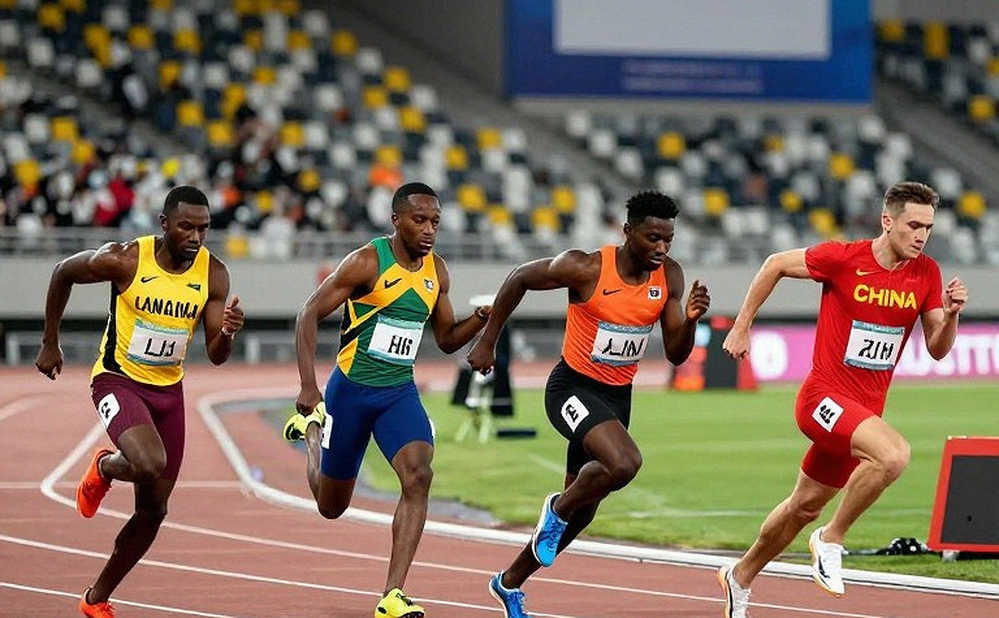
Three items carry no time, no split, no reaction time, no wind reading. Two field items carry hard distances. That asymmetry is the real story of the day. Where numbers are missing, the narrative gets louder; where numbers exist, the narrative gets quieter — that is the hidden architecture of this roundup.
The fourth lane is where the broadcast stops lying.
Context: at these Games, the risk is non-selection, not non-qualification
The Asian Games run on a fundamentally different entry logic from the Olympics or World Championships, and Bengali-language sports coverage rarely spells this out. At an Olympics you clear an entry standard or chase ranking points. Here there is no wall. Entry is an NOC quota allocation; the national federation decides who boards the plane.
That shifts the structural risk for an Indian athlete from failing to qualify to failing to be picked. When selection sits with a federation, team decisions outweigh individual form.
After Day Six, India sit 12th with 22 medals. The roundup itself places that against the 28 gold of Hangzhou 2026. There is a trap here, and it is journalistic: mid-Games medal-table comparisons are structurally misleading, because medal-rich sports are scheduled unevenly across a Games. Swimming and athletics arrive in a first-week block; kabaddi and hockey land late; shooting is scattered throughout. Twelfth is a snapshot, not a verdict.
The framing also reveals something else. Athletics medals are repeatedly dressed as historic and inspirational because they are scarce within India's medal economy. Shooting, kabaddi, hockey, badminton, squash — that is where the depth sits. Not the track. So when a bronze becomes history, recognise that the history comes from a shortage, not from a surplus.
Eighteen years of reading results sheets has taught me one rule: the louder the adjective, the weaker the number.
Core: four results, four different data failures
Start with the largest analytical hole. This document contains no time for Gulveer Singh's 10,000m silver, no time for Thennarasu's heat win, no wind readings, no splits. Any claim about the quality of those performances rests on inference, not measurement.
One thing is legible without a clock. The roundup says Gulveer ran the last 400m extremely well, and that two Bahraini runners worked tactically against him. Read together, that tells you the shape of the race. This was not a time trial. It was a final-lap contest in which Gulveer was the marked man — and surviving a coordinated team effort in a championship final is worth more than a fast clock. For reference: the world record is 26:11.00 (Cheptegei, 2026); the Paris entry standard was 27:00.00. Tactically decided finals usually land in the 28:00–29:00 band. That is inference, not a claim, and without a time the inference stops there.
Balance that against Bahrain's structural picture. Two runners from one federation coordinating to control an opponent is the signature of an imported, group-trained distance squad. Legal and standard, but a capability asymmetry. India has one credible contender at 10,000m. Bahrain has a group. That gap between group depth and single-athlete strength will set India's medal ceiling in the 5,000m, 10,000m and steeplechase for the coming cycle.
Thennarasu's heat win is a low-information datapoint. A late surge is a good shape signal, but it happened in a heat, and heat-to-final conversion in the 400m is notoriously noisy. World record 43.03 (van Niekerk, 2026); Paris standard 45.00. He also won mixed 4×400m relay silver on Thursday, so he is carrying relay legs and individual rounds together. That is a load-management question, not yet a crisis — the crisis, if it comes, arrives in the final, not the heat.
The field events, where the numbers exist, are brutally honest. Elangovan's 4.15m is historic for India. The world record is 5.06m (Isinbayeva, 2026); the Paris standard was 4.73m. That is roughly 0.91m below the world record and 0.58m below the global entry mark. At Hangzhou 2026, women's pole vault gold was contested around 4.6m. A 4.15m bronze implies the traditional Asian pole vault order — historically China-led — was either absent or off-cycle in Aichi. Historic by precedent, ordinary by absolute standard. Holding both truths at once is the job.
Manpreet Kaur's 17.17m sits against a world record of 22.63m (Lisovskaya, 2026) and a Paris standard of 18.80m — about 1.63m short. That distance says more about the depth of the Asian women's shot put field than about the athlete's ceiling. One caution: 'Manpreet Kaur' is a shared name in Indian athletics, and the source offers no disambiguation. Treat the data point as pending verification.
And then the mixed 4×400m relay silver — the most undervalued result of the day. Relay medals require four athletes at a coordinated standard, a functioning exchange and coaching continuity. Structurally, India's most valuable return on Day Six was not a bronze. It was a relay silver.
Two of the four athletics medallists are identified as Tamil Nadu athletes. That is a regional talent-concentration signal that cuts both ways: genuine regional strength, or uneven distribution of development resources. The document does not answer it.
One asymmetry matters analytically. The roundup names a shooting coach. It names no athletics coach. Where a reporter stood in the stadium and where they merely read a scoreboard shows up in the word choices.
Contrarian: who benefits from the word 'historic'
Nothing here is an accusation against the athletes. Two silvers in one season for Gulveer Singh, a first national medal for Elangovan, a podium for Kaur — all real work.
The question is structural. Why do 4.15m and 17.17m get filed under historic rather than audited inward? Partly media framing, partly a quota system that removed the hard wall of an entry standard. When national selection is the entry path, the definition of historic also becomes national — cut loose from global benchmarks.
Consider the cautionary model from the same day's roundup. India's defending men's badminton doubles champions exited in the first round, having won the opening set 21-12. That is a laboratory demonstration of narrative fragility. The frame that manufactures expectation is the frame that later demands an accounting of it. Elangovan's 4.15m is a celebration today; next cycle the question becomes why it was not 4.40m. That question belongs to the institutions that build courts and fund coaches, not to the vaulter.
A third angle: the season plan. Gulveer Singh appears to have been peaked twice in roughly eight weeks — Commonwealth Games 2026 and Asian Games 2026. For a 10,000m profile that sits at the edge of accepted periodisation. He landed both. The roundup presents this as unambiguous success; physiologically it was a controlled gamble that happened to pay.
Day Six was a breadth day, not a dominance day. Silver, bronze, bronze and a heat win is a strong aggregate return, and not one of the four indicates a continental No. 1 in the making at the reported marks. Bronze-level breadth and gold-level depth are different things, and conflating them is the easiest error on a day like this.
One claim must be explicitly withheld. There is no doping signal in this document at all — no adverse finding, no investigation, no anomalous improvement data. Bahrain's transfer-of-allegiance model is a legal eligibility structure, not an anti-doping story, and conflating the two is an analytical error. But no personal bests, season bests or career trajectories are supplied either, so an anomaly screen cannot be run. Not a failure of selection — an absence of testing.
I host the noise, but I study the silence between cues. On this day the silence sat exactly where the timing device should have been.
Takeaway
A false start is not failure; it is the first honest data point. The honest result of Day Six is not the medal list. It is the timing sheet nobody published.
Three things to watch. First, the real times in the 10,000m and 400m — they will tell us whether Gulveer's silver was a tactical win or a genuine step up. Second, whether 4.15m is Elangovan's personal best; that answers whether Aichi was a rung on a ladder or the end of a roof. Third, whether the Tamil Nadu clustering reflects distributed investment or its absence.
A ghost lane teaches you what remains when the applause is switched off. In Aichi-Nagoya it leaves four names, two numbers and two empty cells — and those empty cells will decide whether these medals grow over the next four years or stay in the display cabinet.
Every fan zone has a 0.100 rule; most crowds never hear the gun. In Aichi the gun sounded. Nobody read out the pad.