
HomeKabaddiKabaddi: From Clay Courts to a Commercial Arena — A Full Cross-Section of a Sports Economy
Kabaddi: From Clay Courts to a Commercial Arena — A Full Cross-Section of a Sports Economy
সারসংক্ষেপ: কবাডি একটি দেশীয় খেলা, যা ১৯৯০ সালে এশিয়ান Gamesের আনুষ্ঠানিক ক্রীড়া হিসেবে যুক্ত হয় এবং ২০১৩ সালে ফ্র্যাঞ্চাইজি-ভিত্তিক পেশাদার League চালুর পর বাণিজ্যিকভাবে বড় পরিসরে বিস্তৃত হয়। প্রশ্ন: কবাডির মূল নিয়ম কী? উত্তর: একজন রেইডার প্রতিপক্ষের অর্ধে ঢুকে টানা শ্বাসে ধ্বনি উচ্চারণ করে; সফল রেইড, সফল ট্যাকল ও প্রতিপক্ষের পুরো দল আউট হলে বোনাস পয়েন্ট—এই তিন উৎসে স্কোর নির্ধারিত হয়। প্রশ্ন: International অঙ্গনে ভারসাম্য কীভাবে বদলেছে? উত্তর: ভারত দীর্ঘদিন মানদণ্ড ঠিক করলেও ইরান এখন ফাইনাল পর্যায়ের প্রতিদ্বন্দ্বী; প্রতিদ্বন্দ্বিতা বাড়ায় প্রযুক্তিগত ও কৌশলগত বিকাশ ত্বরান্বিত হয়েছে। প্রশ্ন: পেশাদারিত্বের মূল ঝুঁকি কী? উত্তর: আয়ের অসমতা, ক্যালেন্ডার চাপে চোট, স্বচ্ছ চুক্তি ও সুশাসনের ঘাটতি, এবং ম্যাচ-ফিক্সিং ঝুঁকি। প্রশ্ন: মহিলা কবাডির Status কী? উত্তর: ২০১০ সাল থেকে এশিয়ান Gamesে মহিলাদের প্রতিযোগিতা আছে, তবে পুরুষদের মতো বাণিজ্যিক League প্ল্যাটForm নেই—এতে প্রতিভার অপচয় ঘটে। প্রশ্ন: সংবাদমাধ্যমে সবচেয়ে বড় দুর্বলতা কী? উত্তর: তথ্যসূত্রের স্তর বিভাজন না থাকা—প্রাথমিক সাক্ষাৎকার, সংবাদসংস্থা ও যাচাইহীন সামাজিক মাধ্যমের দাবি একসঙ্গে মেশানো, এবং জাতীয় দল-কেন্দ্রিক নায়ক-নির্মাণ ও Leagueের বাণিজ্যিক ভাষার পক্ষপাত।
Kabaddi carries more than one identity at once. One belongs to its origin: an open village field, dust, bare feet, a solo expedition into the opponent's half while holding the breath. The other belongs to its present: synthetic mats, television cameras, franchise ownership, sponsorship and professional contracts. The distance between these two identities is smaller than it appears. Kabaddi has grown because it did not forget its roots, and it has survived because it learned to change three things at once: its rules, its presentation and its market. In a region dominated by cricket and football, how a homegrown sport carves out its own space is the central question here.
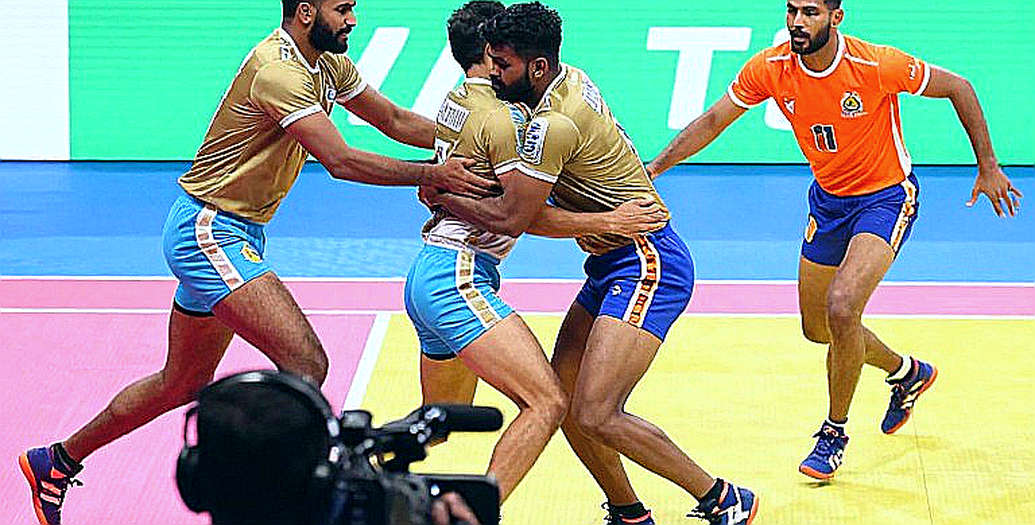
The structure of the game is simple; the arithmetic inside it is not. A raider enters the opponent's half and chants kabaddi on a single breath; if the breath stops or the raider fails to return safely, it is out. Within that brief window the raider must touch one or more defenders and return, while the defenders try to hold him. Successful raids score, successful tackles score, and a bonus point comes when an entire side is put out. Modern rules fix the raid clock, punish careless dives, and subject the moments when defenders hold a raider to video review. This mechanical clarity has made kabaddi easier for spectators, but it has also narrowed the player's room for improvisation.
The surface has changed, and so has the body's language. On clay, feet slip, balance in the tackle is difficult, but joint load is comparatively low. On synthetic mats, speed is higher, friction burns the skin, and the load on knees and ankles rises. The same player must display different skills in two environments. The gap between an international mat and a rural field says exactly how varied kabaddi's habitats are. That variety is both strength and risk: if the training system is built around one kind of surface, talent from the other environment can be lost. Coaching methods show the same divide—mat play demands strength and balance drills, clay play demands the habit of managing awkward falls.
The national setup depends on training camps, physical testing and step-by-step selection. At events like the Asian Games, medals rest on this chain, because scouting, match pressure and recovery time are all limited. Kabaddi became an official Asian Games sport in 2026, and that event has since been the anchor of the international calendar. National programmes are therefore built around that cycle; club competition supports preparation but cannot replace it. Where the domestic circuit is weak, national results stay uncertain—a relationship clearly visible in kabaddi.
India set the benchmark for a long time, but the story of single dominance is no longer the whole truth. Iran has reached a level where it contests any final, built on tactical discipline, physical strength and tackling craft. Iran has repeatedly reached Asian Games finals and has beaten India or come very close, proving that the sport is not one country's property. This rivalry has helped kabaddi: technical development accelerated, and new thinking entered rules and training. A sport without genuine competition loses audience interest; kabaddi has avoided that path.
In Bangladesh, kabaddi received national status shortly after independence—a rare case where state recognition turned a mass grassroots culture into formal standing. The strength of Bangladeshi kabaddi lies in rural culture; its weakness lies in training infrastructure and the inexperience that comes from too few international matches. National teams compete internationally, but sustained competitiveness is hard to maintain when quality opposition is scarce year after year. Regional leagues and bilateral series are the most practical fix, but they require stable investment and calendar planning.
The commercial turn came in 2026, when a franchise-based professional league launched. Its impact runs both ways. Player incomes, visibility and recognition reached levels previously unimaginable; at the same time the environment of the game was transformed—floor-based mats, full lighting, broadcast-driven scheduling. Franchise ownership means teams are no longer only sporting units but entertainment products. This transformation brought unprecedented promotion for kabaddi, yet it also raised a question: where is the balance between league commercial interest and national team needs? If the calendar is built around the league, national camp time shrinks; if the reverse, franchise investment is harder to justify.
The league economy rests on three pillars: broadcast, sponsorship and tickets. Broadcast revenue is the largest share of team budgets, because the game's tempo suits television—quick matches, short breaks, more advertising slots. Sponsorship comes mainly from sports-adjacent brands and regional companies. Ticket income is comparatively small, yet a loud crowd makes the broadcast feel alive; attendance therefore signals not only revenue but product quality. The weakness is dependence: if a broadcast deal changes or the advertising market slows, smaller-budget teams come under pressure first. A sustainable model needs diversified income—merchandise, academies and regional events.
Player livelihoods have changed, but unevenly. Once kabaddi was sustained by railway, police or government jobs, where athletes always lived behind another profession. In the professional era that reality has shifted, but mostly at the top. Leading league players earn significant sums, while second-tier players, women and rural athletes remain outside that safety net. A professional career is short—surviving two decades at international level is rare. Injury is the biggest risk: ankle, knee and shoulder injuries are routine. Without investment in rehabilitation, contract protection and education for a second career, professionalism stays incomplete.
Foreign players, especially Iranians, have changed the league's quality and character. Their tackling craft, physical preparation and discipline have set standards that local players can learn from. The foreign-player quota forces teams to balance: too many imports stifles local development, too few lowers match quality. Beyond the quota lies another question—foreign presence turns the league into an international product, but if that internationalism stays within one region, market expansion is limited.
Women's kabaddi is the most important chapter of this story. It entered the Asian Games in 2026, and India's women's team has set the benchmark since. Despite reaching high training standards, many skilled players from Maharashtra, Haryana, Bengal and Tamil Nadu stay outside the international stage because competitions are few. There is no commercial platform comparable to the men's league—a question not only of fairness but of waste, since talent slips away for lack of visibility. A women's league is justified not only by equity but by the market.
Grassroots discussion is inseparable from kabaddi. Rural tournaments, school and university competitions form the supply line. The problem is uneven scouting: talent from villages cannot compete with those who gained entry to city mat-based academies. The coaching gap is even bigger—a coach not trained on mats cannot teach the nuances of international rules. The solution is organisational, not technological: regional coach-training centres, regular school tournaments and transparent talent-identification testing.
Technology is now part of the game. Match statistics—raid success rate, tackle success rate, super tackles, time to an all-out—shape team decisions directly. Video analysis identifies opponent habits, and review technology has reduced match disputes. But data alone does not produce good decisions; reading data requires capability and organisational discipline. For smaller-budget teams an analyst is expensive, creating a risk that a technical gap becomes an income gap.
The biggest gap in sports journalism appears at the level of sourcing. A report built only on match scores and team statements carries no picture of player condition, injuries, contract reality or training conditions. Sources should be tiered: first, direct observation and primary interviews; second, wire reports and official statements; third, social media claims that cannot be used without verification. Two biases recur in kabaddi coverage—exaggerated hero-building around national teams, and the language of the commercial side in league reporting. Both rely more on emotion or promotion than on verifiable fact. A report without clear source, date and method is not analysis; it is opinion.
The list of challenges is long. First, income inequality—the gap between top and marginal teams keeps widening. Second, calendar pressure: league, national camps and international events together damage players' bodies. Third, governance: without transparent contracts, a real role for a players' association and clear injury-disclosure rules, trust does not build. Fourth, betting and match-fixing risk—in a sport where scores swing fast and raid decisions are individual, suspicion grows quickly; monitoring and investigation systems must be strengthened.
Two practical themes dominate the future debate. First, regional expansion: spreading competition to West Asia, Africa and Europe beyond South Asia raises standards, but not through invitational tournaments alone—local coaches and referees must be developed. Second, the Olympic question: it has been discussed, but any decision will depend on member-nation count, visible markets and technical standards. Making a homegrown sport global requires an environment of trust: stable rules, transparent administration and a culture of listening to players.
The conclusion is simple. Kabaddi's strength is its simplicity—one person, one breath, one decision. That simplicity kept it alive in the television age, and that same simplicity never protected it from the complex pressures of market and administration. Professionalism brought money and visibility; but if professionalism means only league revenue while training, women's competition and rural supply are neglected, this rise will be temporary. The real measure of kabaddi is not medals or broadcast numbers alone—it is whether a village teenager gets access to mat training, whether a woman player has financial protection after injury, whether a retired player's next life is secure. The answers to these three questions will decide what kabaddi becomes in the coming decade.
Related Players
Recommended
Asian Games 2026 Kabaddi: Bangladesh and Pakistan Top Groups on Day 1, Dramatic Wins Over Korea and Chinese Taipei2026-10-18
Seven Minutes Before the First Whistle: Pawan Sehrawat's Bench, an Unsourced Team Sheet, and the Real Question of a Gold-Medal Final2026-09-26
What the 48–24 Scoreboard Hides: The Real Semifinal Story Against Nepal Is India's Defence2026-09-26
India's Kabaddi Victory at Asian Games 2026: Crushing South Korea 63-31 to Stay on Course for Gold2026-10-02
Why Pawan Sehrawat Isn't in the Final's Starting Seven — And Why the Question Itself Is Weak2026-09-26
The Captain Is Named, the Opponents Are Not: Reading the Silences of the 2026 Commonwealth Kabaddi Championship2026-10-22
Pawan Sehrawat: The Rise of Kabaddi's Flying Star2026-10-15
Pawan Sehrawat Outside the Starting Seven: A Tactical Reading of a Bench Decision and an Unresolved Date2026-09-26
Recommended
The Captain Is Named, the Opponents Are Not: Reading the Silences of the 2026 Commonwealth Kabaddi Championship2026-10-22
Kabaddi: From Clay Courts to a Commercial Arena — A Full Cross-Section of a Sports Economy2026-11-02
The Aichi-Nagoya Kabaddi Final Has Not Been Played: The Unverified 37–34 Scoreline and a Protocol Autopsy2026-09-26
Asian Games 2026 Kabaddi: The Seventy-Five Minutes Between Semifinals, and What 'Unbeaten' Leaves Out2026-10-03
Commonwealth Kabaddi Championship 2026: Three Cracks Hidden Beneath the Logo Reveal2026-10-14
Kabaddi: From Clay Court to Broadcast Stage — Professional League, National Teams and the Real Map of News Coverage2026-11-02